
AWD vs 4WD: What’s the Difference and Which Suits Your Needs?
November 12, 2026
Categories:
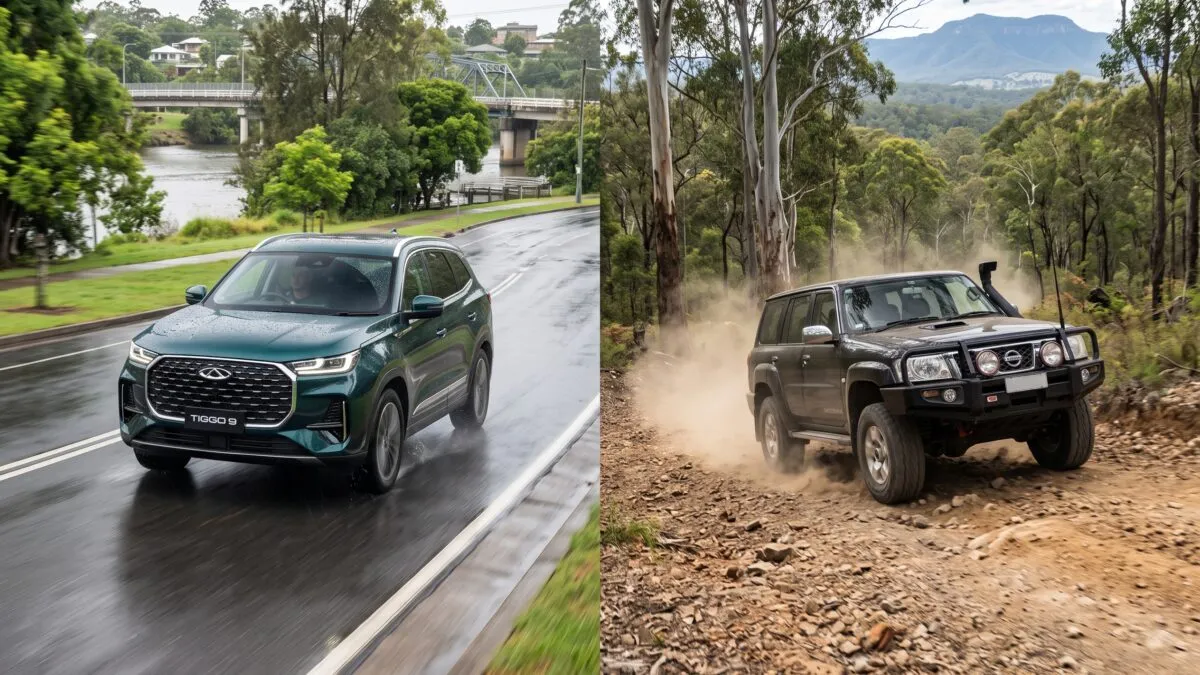
Weighing up AWD vs 4WD is one of the first decisions Australian drivers make when shopping for everyday passenger cars, family SUVs and dual-cab utes. Ultimately, the decision rests on determining which drivetrain best suits your lifestyle, towing demands and driving habits.
At Boettcher Motors, we’ve helped countless guests choose the best vehicles for their unique circumstances. Whether you’re city driving into Ipswich, commuting across the Bremer River or taking the family out for weekend off-road adventures near the Scenic Rim, understanding the difference between AWD and 4WD helps you choose a vehicle that suits your needs long-term.
In this guide, we’ll break down all-wheel drive vs 4WD layouts across our four franchise brands, Kia, Nissan, Volkswagen and Chery.
Contact Our Team | Explore Used Cars
What is All-Wheel Drive?
An all-wheel drive (AWD) setup is a complex wheel drive system designed to deliver a more stable driving experience and improved traction compared to standard two-wheel drive vehicles. AWD vehicles are best suited to paved roads, wet pavement and loose gravel.
Instead of requiring manual driver input, modern AWD systems rely on smart computer sensors. When a wheel loses traction, the system redirects engine power to the wheels with more grip, often working alongside traction control to limit extra wheel spin.
While AWD vehicles excel on slippery bitumen and minor off-road tracks, they lack low-range gearing and are not engineered for technical rock crawling or more extreme off-roading.
On-Demand AWD Systems
Common among passenger cars, urban crossovers and modern electric cars, many on-demand systems run primarily as a front wheel drive setup during standard highway cruising to remain fuel efficient.
When sensors detect front-wheel slip, power automatically routes to the rear wheels.
On-demand AWD models: You can experience this intelligent setup on our floor in the Chery Tiggo 9 Super Hybrid, dual-motor Kia EV5 AWD and AWD variants of the Kia Sportage.
Full-Time AWD Systems
A full-time AWD system sends engine power to both the front and rear axles continuously. Some models use a mechanical or electronic centre differential to enable the front and rear wheels to rotate at different speeds, providing safety on wet highways and unsealed dirt roads.
Full-time AWD models: Full-time AWD systems are featured across Volkswagen’s 4MOTION lineup, including the Volkswagen Tiguan, Tayron and Touareg.
What is Four-Wheel Drive (4WD)?
A four-wheel drive (4WD) system is a drivetrain built specifically to navigate off-road conditions and rough terrain like deep sand, deep snow, heavy mud and steep inclines. 4WD vehicles are also capable of towing heavy loads.
Unlike an AWD setup, a traditional 4WD system uses a mechanical transfer case to connect the drive shafts. When engaged in four-wheel drive mode, the transfer case mechanically couples the front and rear drivetrains so the front and rear driveshafts turn at the same speed.
High Range (4H) vs Low Range Gearing (4L)
- 4H (4WD High Range): Suitable for driving over loose, slippery or unpaved off-road terrain at moderate speeds, such as corrugated dirt tracks or firm beach sand.
- 4L (4WD Low Range): Engaged via a dial or switch while stationary or at very low speed (check your owner’s manual for your model). Low range gearing alters the internal gear ratios within the transfer case to multiply torque at low speeds. This gives off-road enthusiasts maximum traction, control and engine braking.
You can find selectable four-wheel drive systems across our dual-cab ute and SUV lineup. Key models include the Kia Tasman 4×4, Nissan Navara 4×4 and Nissan Patrol.
Understanding 4×2 vs 4×4 on Ute Spec Sheets
When browsing ute spec sheets, buyers frequently encounter the terms 4×2 and 4×4.
- 4×2 (two-wheel drive utes): In ute spec sheets, 4×2 indicates a Rear Wheel Drive layout where power goes exclusively to the rear axle wheels. Models like the Kia Tasman S 4×2 or Nissan Navara 4×2 typically offer higher payload capacity, lower purchase prices and better fuel economy for tradespeople who mostly drive around town.
- 4×4 (selectable four-wheel drive utes): Adds a front differential, front driveshafts and a dual-range transfer case. Drivers can choose to operate in 2H on dry pavement, engaging 4H or 4L only when entering worksites, unpaved roads or off-road trails on models like the Kia Tasman 4×4 and Nissan Navara 4×4.
Running Costs: Fuel-Efficient Driving, Servicing and Tyres
Understanding long-term running costs is a crucial step when weighing up AWD and 4WD options. While initial purchase prices vary by model grade, ongoing expenses and fuel efficiency depend heavily on drivetrain design and driving habits.
Fuel Economy
- AWD Vehicles: Carrying an extra rear differential and driveshaft adds weight compared to standard two-wheel drive vehicles. While on-demand AWD systems stay relatively fuel efficient by sending power to only one axle during highway cruising, full-time systems continuously send power to all four wheels, so more fuel may be used over time.
- 4WD Vehicles: Heavy-duty transfer cases, solid axles and reinforced chassis components add mass. Running in rear wheel drive (2H) mode keeps daily fuel economy reasonable for urban driving, but engaging four-wheel drive mode on off-road trails increases fuel consumption.
Tyre Wear and Maintenance
- AWD Cars: Because power is distributed across left and right wheels and front and rear axles, tyres typically wear evenly if rotated regularly. Many manufacturers also recommend replacing all four tyres at once, as mismatched tread depths can put extra strain on AWD systems.
- 4WD Vehicles: For heavy dual-cab utes and 4×4 SUVs, regular five-tyre rotations (including the full-size spare) may be recommended to keep all five tyres wearing evenly.
Which System Suits Your Lifestyle?
Choose All-Wheel Drive (AWD) if You…
- Need a great suburban vehicle for everyday city driving, school runs and highway commutes.
- Value extra grip on paved roads, wet pavement and unsealed gravel tracks without having to turn dials or lock axles manually.
- Tow light to medium caravans, horse floats or boats on sealed roads or paved launch ramps (within the vehicle’s rated towing capacity).
Choose Four-Wheel Drive (4WD / 4×4) if You…
- Spend weekends seeking epic rough-terrain adventures, soft beach sand driving or heavy mud tracks.
- Tow heavy commercial trailers, large caravans or multi-ton boats.
- Require low-range gearing, a rear differential lock or a central differential lock to get through unpredictable off-road conditions.
- Need the working versatility of a dual-cab ute or full-size ladder-frame SUV for heavy worksite payloads.
Which Drive System Is in Each Model?
Here’s how each of the wheel drive systems covered above lines up across our range:
| Drive system | How it works | Models at Boettcher Motors |
|---|---|---|
| Front-wheel drive | Power to the front axle only | Most Chery Tiggo, Kia Sportage and Volkswagen T-Cross grades |
| On-demand AWD | Front-drive until sensors detect slip | Chery Tiggo 9 Super Hybrid, Kia EV5 AWD, Kia Sportage AWD variants |
| Full-time AWD | Power to both axles at all times | Volkswagen Tiguan, Tayron and Touareg 4MOTION |
| Rear wheel drive (4×2) | Power to the rear axle only | Kia Tasman 4×2, Nissan Navara 4×2 |
| 4WD with low range (4×4) | Dual-range transfer case, 2H/4H/4L | Kia Tasman 4×4, Nissan Navara 4×4, Nissan Patrol |
Experience the Difference at Boettcher Motors
At Boettcher Motors, you can compare AWD SUVs and 4WD utes side by side and explore both layouts across our Kia, Nissan, Volkswagen and Chery ranges.
Browse our range of used and demo vehicles online, or book a test drive today!
AWD vs 4WD – FAQs
Which is better, AWD vs 4WD?
Neither system is universally better. Instead, your choice depends entirely on your lifestyle. The key differences between 4WD vs all-wheel drive come down to how power is sent to the wheels. All-wheel drive makes a great suburban vehicle choice for everyday on-road safety, wet weather stability and unsealed dirt roads because it automatically provides more traction without driver intervention. Four-wheel drive is well-suited for extreme off-roading, deep sand, mud and heavy towing where low-range gearing and locked axles are essential to navigate rough terrain.
What are the key differences between how AWD and 4WD distribute power?
The primary mechanical distinction lies in how power reaches the axle shafts. An all-wheel drive system varies power distribution between axles automatically, allowing wheels to rotate at different speeds so the vehicle can turn smoothly on dry pavement. In contrast, a four-wheel drive system typically requires manual activation by the driver to switch from 2H into 4H or 4L off-road modes. When engaged, the transfer case mechanically locks the front and rear drive shafts together to drive all wheels equally at the same speed. This provides maximum traction in loose sand or heavy mud.
What Are the Disadvantages of AWD?
AWD adds weight, complexity and cost compared to two-wheel drive vehicles, which can mean higher fuel consumption and more components to maintain. Most AWD systems also lack low range gearing, so they aren’t designed for extreme off-roading, steep rocky climbs or soft sand. AWD cars can also be sensitive to mismatched tyres, so replacing tyres in sets of four is often recommended.
Is AWD good for towing on-road?
Yes, an all-wheel drive system provides improved traction and enhanced stability when towing trailers, horse floats, or boats on paved roads, wet pavement and slippery boat launch ramps. Keep in mind that towing capacity is set by the manufacturer for each model, not by the drivetrain alone, so always check the rated capacity before you hitch up. However, if your towing route involves deep sand, steep off-road tracks or difficult or uneven terrains, a dual-range four-wheel drive 4WD vehicle is recommended.
Does good tyre quality matter as much as having AWD or 4WD?
Yes. While AWD and 4WD systems manage how engine power reaches your wheels, your tyres are the only four points of contact connecting your vehicle to the road surface. Good tyre quality is essential for wet-weather performance, braking distance and aquaplaning resistance during heavy downpours. Even the most advanced AWD systems cannot generate traction if tyre tread is worn down.
| See Available Cars | Book A Service | Source Parts & Accessories |


